An interesting case is discussed in the article “Bilateral Jaw Mycobacterium Abscessus Mimicking Actinomycosis: A Postoperative Complication of Wisdom Teeth Extraction” written by Michael Johanis and et. al. Published, June 13, 2024. The article discusses how nontuberculous mycobacteria infections has surged over recent decades. They report a case of a 22-year-old healthy female who had with bilateral mandibular nodules after wisdom teeth extraction.
The young woman experienced a scare after getting her wisdom teeth removed. While doctors first suspected a common infection called actinomycosis, cultures revealed a Mycobacterium abscessus infection susceptible to macrolides. This bacteria is becoming more prevalent and can be difficult to diagnose because it mimics other infections, like actinomycosis. This can lead to delays in getting the right treatment.
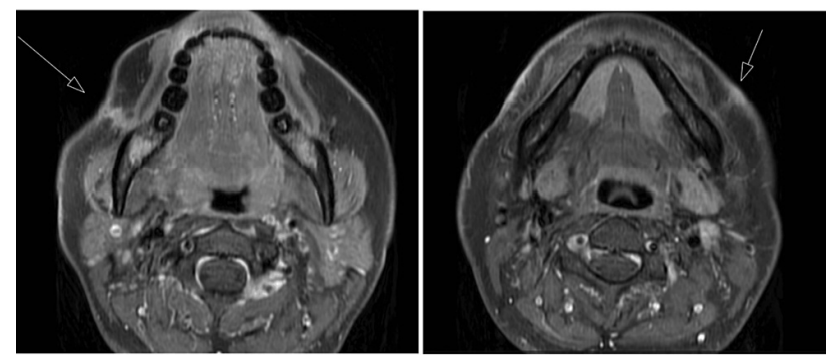
The key to getting the right treatment is early and accurate diagnosis, which is often achieved through culture testing. This helps identify the specific bacteria and determine which antibiotics it’s susceptible to. The woman had Magnetic resonance imaging scan done which showed bilateral sinus tracts without osteomyelitis.
From Bilateral Jaw Mycobacterium Abscessus Mimicking Actinomycosis: A Postoperative Complication of Wisdom Teeth Extraction” written by Michael Johanis and et. al. Published, June 13, 2024 and licensed under a the Creative Commons Attribution License CC-BY 4.0.
Initial MRI of the woman (A) A tract of edema and enhancement that extends to the skin surface, where there is mild puckering, thickening, and enhancement. (B) A linear tract of subcutaneous soft tissue edema and enhancement leading to the overlying skin surface, with mild skin thickening and enhancement but without puckering.
The woman was given dual antibiotic therapy, consisting of azithromycin and omadacycline, without surgical intervention. Given her clinical and radiographic improvement after three months, the patient continued dual antibiotic therapy for 12 months with clinical and radiographic monitoring. This case highlights the importance of seeking medical attention promptly after dental procedures if you experience an infection. It also emphasizes that different types of bacteria can cause infections, and testing is crucial to determine the most effective course of treatment. Early diagnosis can help prevent complications and the need for surgery. Doctors must successfully differentiate between and appropriately treat various nontuberculous mycobacteria.