Artificial intelligence is transforming healthcare, but it is also creating new risks. One of the biggest emerging concerns is the rise of deepfake X-rays—AI-generated medical images that can look realistic enough to fool trained experts. While this issue affects healthcare broadly, it has a particularly important dental angle because dental X-rays play such a central role in diagnosis, treatment planning, insurance claims, and patient records.
A recent study (Mickael Tordjman, Murat Yuce, Amine Ammar, Mingqian Huang, Fadila Mihoubi Bouvier, Maxime Lacroix, Anis Meribout, Ian Bolger, Efe Ozkaya, Himanshu Joshi, Amine Geahchan, Rayane El Rahi, Haidara Almansour, Ashwin Singh Parihar, Carolyn Horst, Samet Ozturk, Muhammed Edip Isleyen, Gul Gizem Pamuk, Ahmet Tan Cimilli, Timothy Deyer, Arvin Calinghen, Enora Guillo, Rola Husain, Jean-Denis Laredo, Zahi A. Fayad, Xueyan Mei, Bachir Taouli. The Rise of Deepfake Medical Imaging: Radiologists’ Diagnostic Accuracy in Detecting ChatGPT-generated Radiographs. Radiology, 2026; 318 (3)) found that both radiologists and AI models had difficulty reliably telling real X-rays from AI-generated ones. Even experienced doctors were not always able to spot the fake images, especially when they were not warned in advance. For dentists, oral surgeons, and dental practices, that finding raises serious questions about the future security and authenticity of digital dental imaging.
Why Deepfake X-Rays Matter in Dentistry
In modern dentistry, imaging is essential. Dental X-rays help detect cavities, infections, bone loss, fractures, impacted teeth, cysts, and other conditions that may not be obvious during a visual exam. Dentists also rely on X-rays to document treatment needs, monitor healing, support referrals, and communicate with insurers and specialists. If a fake image enters that workflow, the consequences could be significant.
A deepfake dental X-ray could potentially be used to support a fraudulent insurance claim, exaggerate an injury in a legal dispute, or misrepresent a patient’s oral health history. In a worse-case cybersecurity event, altered radiographs placed into a digital chart could influence diagnosis and lead to inappropriate treatment decisions. That makes dental imaging cybersecurity an issue dental professionals may need to take much more seriously in the AI era.
What Fake X-Rays May Look Like
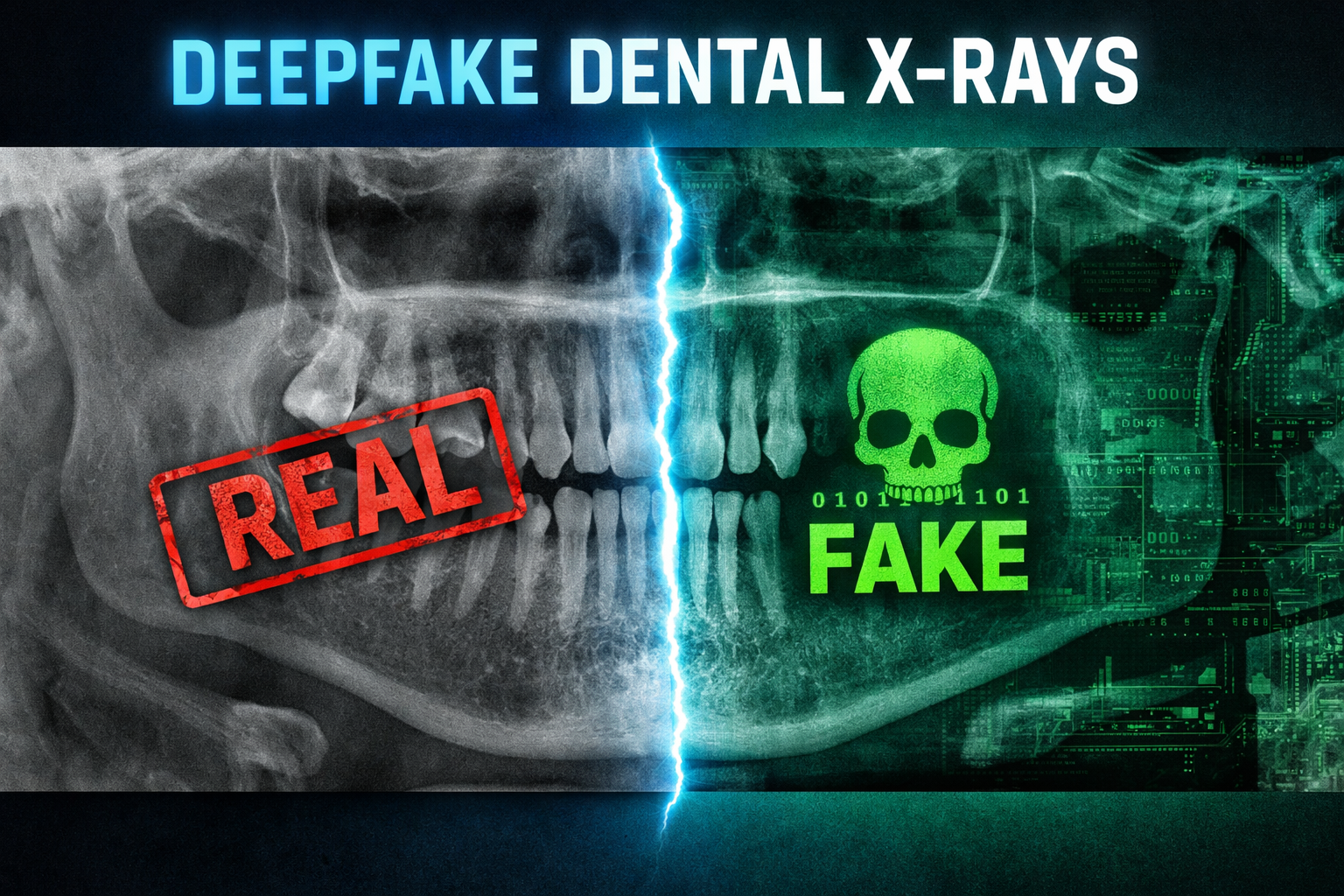
Researchers found that synthetic medical images often appear almost too perfect. Reported clues included overly smooth bones, overly symmetrical anatomy, and structures that looked unnaturally uniform. In a dental setting, those same kinds of patterns could matter. Real teeth and surrounding bone usually show subtle irregularities, natural asymmetries, and patient-specific variation. If a dental radiograph looks unusually polished or unnaturally consistent, it may deserve a second look.
Of course, not every clean-looking image is fake. But the findings suggest that future dentist training may need to include more awareness of AI-generated imaging and possible image manipulation.
Experience Alone May Not Prevent Misdiagnosis
One of the most concerning findings was that years of experience did not guarantee better detection of fake images. That means this is not simply a problem that can be solved through clinical experience alone. Even well-trained experts can be deceived when an image looks realistic enough. For dental practices, that points to the need for technical protections, not just sharper eyes.
How Dental Practices Can Respond
As AI in dentistry continues to expand, practices may need stronger safeguards to protect the integrity of their imaging systems. The study highlights possible protections such as invisible watermarks embedded into images and cryptographic signatures linked to image capture. Similar tools could help dentists verify that a dental X-ray is authentic and has not been altered after it was taken.
This will become even more important as more dental offices adopt cloud-based imaging, remote consultations, AI-assisted diagnostics, and integrated digital record systems. The more connected the workflow, the more important image authenticity in dentistry becomes.
The Future of Trust in Dental Imaging
For years, dental X-rays have been treated as objective evidence of disease, trauma, healing, and treatment need. But as deepfake medical images become more convincing, dentists may need to think differently about trust in digital records. The future of dental radiology may depend not only on interpreting what an image shows, but also on confirming that the image is real in the first place.
The takeaway is clear: deepfake dental X-rays could become a real challenge for oral healthcare. Dentists, oral surgeons, and dental organizations should start thinking now about dental imaging security, clinician education, and tools that help protect the authenticity of patient images. In the AI era, safeguarding trust in radiographs may become just as important as capturing them.