Wisdom teeth are usually discussed in a very practical way: do they need to come out, are they impacted, and are they causing pain? But a recent study suggests they may also offer clues about something bigger: the shape and symmetry of the jaw itself. In a 2026 Cureus paper (Influence of Asymmetrical Eruption and Impaction Angulation of the Wisdom Teeth on the Craniofacial Morphology), researchers examined whether differences in the eruption or impaction angles of the lower wisdom teeth on the right and left sides are associated with differences in craniofacial morphology. Their conclusion was that patients whose bilateral mandibular wisdom teeth point in different directions tend to show signs of mandibular asymmetry.
The study included patients who had bilateral wisdom teeth and underwent CT imaging before extraction. The researchers grouped patients into a “same-angle” group, where the right and left lower wisdom teeth had similar eruption or impaction directions, and a “different-angle” group, where the two sides differed. Using CT-based reconstructions, they performed lateral and frontal cephalometric analyses and also took three-dimensional measurements of the mandibular ramus and body.
What they found was interesting. The “different-angle” group showed significant differences in several cephalometric measurements, including ANB angle, incisor-mandibular plane angle, Menton-Anterior notch distance difference, and maxillo-mandibular midline angle. These kinds of measurements are used to evaluate skeletal relationships and asymmetry in the face and jaw. In other words, when the lower wisdom teeth on each side are angled differently, that pattern may coincide with a more asymmetrical mandible.
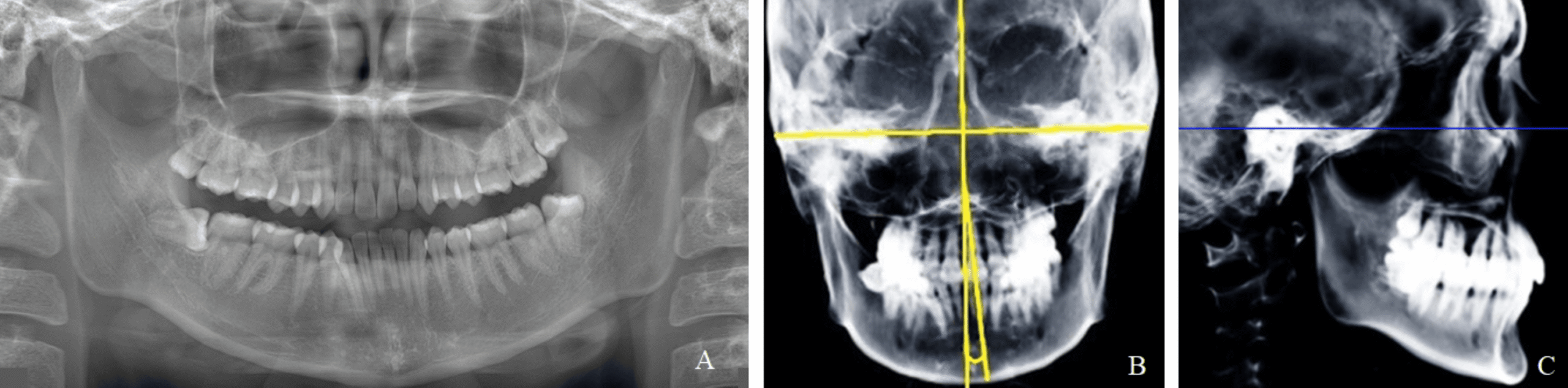
Representative images of the different-angle group A: Panoramic radiograph. B: Mx-Md midline angle is measured in the frontal cephalogram. C: Lateral cephalogram. From the 2026 Cureus paper Influence of Asymmetrical Eruption and Impaction Angulation of the Wisdom Teeth on the Craniofacial Morphology published under a Creative Commons license.
At the same time, the study did not find significant differences in the three-dimensional measurements of mandibular ramus and body length between the two groups. That matters because it suggests the relationship may be more visible in cephalometric alignment and asymmetry markers than in simple size measurements alone. The issue may not be that one side of the jaw is dramatically larger or smaller, but rather that the jaw’s orientation and symmetry differ in more subtle ways.
Why does this matter clinically? For oral surgeons, orthodontists, and maxillofacial specialists, wisdom tooth angulation might serve as another diagnostic clue when evaluating jaw deformities or facial asymmetry. Instead of viewing impacted third molars only as isolated dental findings, clinicians may be able to consider them as part of a broader craniofacial pattern. The authors suggest their findings could help support diagnosis of jaw deformities by incorporating analysis of wisdom tooth eruption or impaction direction.
This does not mean crooked or uneven wisdom teeth cause facial asymmetry outright. The study shows an association, not proof of direct causation. The authors also note that the mechanism linking wisdom tooth angulation and maxillofacial morphology remains unclear. So the more cautious interpretation is that asymmetrical third-molar orientation may be a marker of underlying developmental patterns rather than the root cause of them.
The broader takeaway is compelling: wisdom teeth may hold more information than just whether extraction is needed. Their position and angulation could reflect how the jaws developed over time, especially in patients with asymmetry. As imaging and morphologic analysis become more refined, seemingly routine dental findings may end up contributing to a more complete understanding of craniofacial structure.