Most people think of saliva as something they barely notice—until it is gone. But saliva plays a major role in protecting teeth from acid, bacteria, and enamel damage. New research (Natara Dias Gomes Da Silva, Paulo Sérgio da Silva Santos, Flávio Henrique-Silva, Ana Carolina Magalhães, Marcos Roberto Chiaratti, Elbert de Josselin de Jong, Pamela K DenBesten, Marília Afonso Rabelo Buzalaf. A novel artificial saliva enriched with CaneCPI-5 for irradiated head and neck cancer (HNC) patients: in vitro antimicrobial and anticaries effect. Journal of Dentistry, 2025; 163: 106176) suggests that an artificial saliva made with a sugarcane-derived protein may one day help protect teeth in a way that is much closer to natural saliva. That could be especially important for people with dry mouth, high cavity risk, and hard-to-clean areas such as around wisdom teeth.
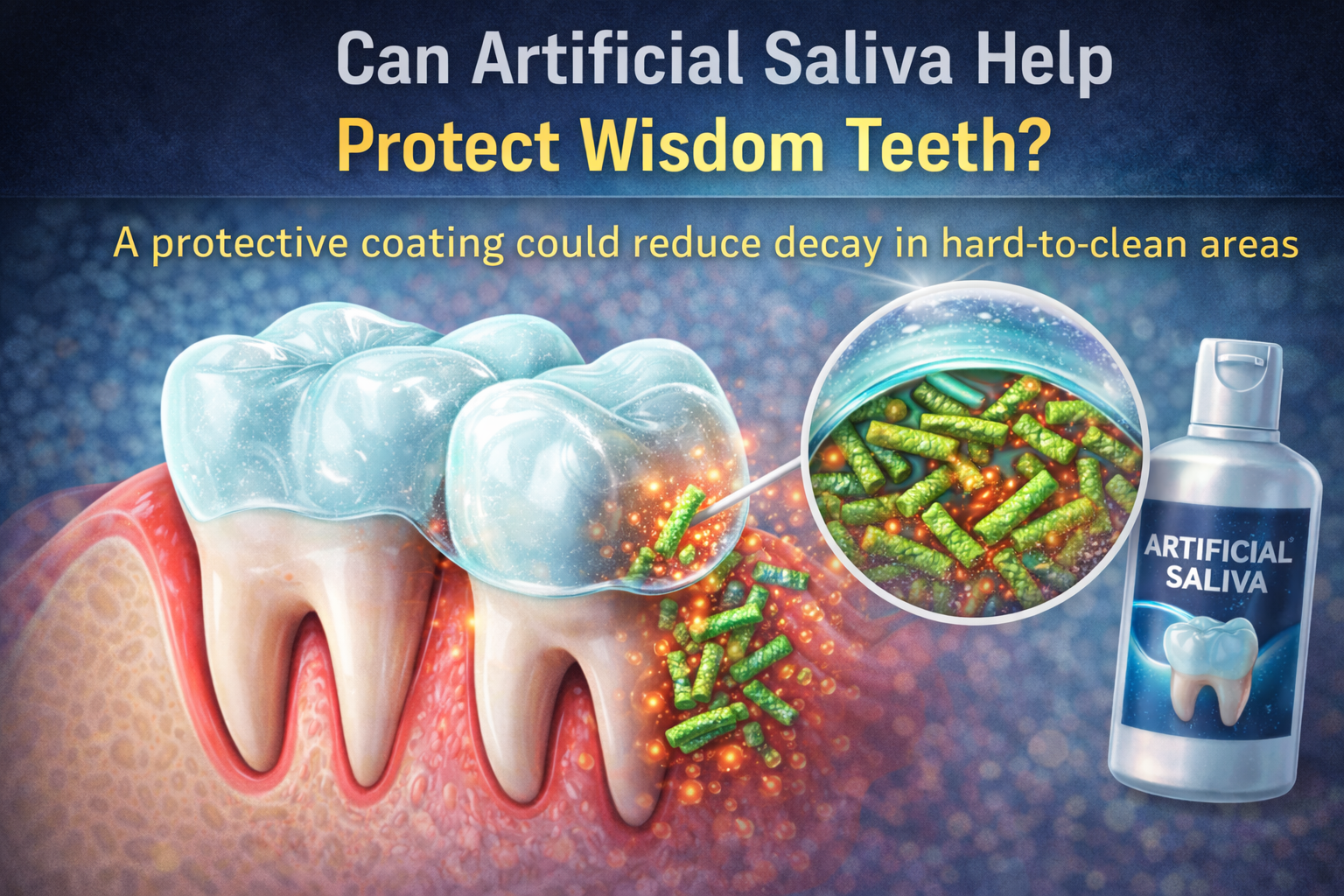
The key ingredient in this new approach is a lab-modified sugarcane protein called CANECPI-5. Researchers found that it can bind directly to tooth enamel and form a protective layer, almost like a shield, against acids and bacteria. In testing, it worked even better when combined with fluoride and xylitol, helping reduce bacterial activity and slow enamel demineralization—the process that makes teeth more vulnerable to cavities.
Why Saliva Matters So Much for Oral Health
Natural saliva does far more than keep the mouth comfortable. It helps neutralize acids, wash away food particles, and control the bacteria that contribute to tooth decay. When saliva production drops, the mouth becomes more vulnerable to cavities, enamel erosion, soreness, and infection.
That is one reason this development is getting attention. The researchers are especially focused on patients with xerostomia, or dry mouth, including people who lose saliva production after radiation treatment for head and neck cancer. These patients often face severe dental problems because they lose one of the mouth’s main natural defenses.
A Wisdom Teeth Angle
This kind of protection could matter even more around wisdom teeth. Wisdom teeth, especially when they are partially erupted or difficult to clean, often sit in the back of the mouth where plaque and food debris are more likely to collect. If a patient also has dry mouth, that combination can create a much higher risk for decay and irritation around those back teeth.
Not everyone keeps their wisdom teeth, but for those who do, anything that helps strengthen enamel and reduce bacterial activity could be especially valuable. Artificial saliva that forms a protective coating may one day offer added support in these higher-risk areas, particularly for patients who struggle with dry mouth or recurrent decay.
How This Artificial Saliva Works
Researchers tested the CANECPI-5 solution as a mouthwash, applying it once a day for one minute to tooth samples. They also evaluated it in other forms, including gel and orodispersible film. Across these different delivery methods, the protein showed strong ability to bind to enamel and help defend teeth from acid-related damage.
The idea is based on the acquired pellicle, the thin protective layer that naturally forms on tooth surfaces. Instead of only replacing moisture, this artificial saliva is designed to rebuild a more protective environment on the teeth themselves. That makes it different from standard dry-mouth products that mainly improve comfort.
More Than a Dry Mouth Product
The researchers say CANECPI-5 is promising not only because it protects enamel, but also because it appears to help regulate oral bacteria. That combination could make it useful for future dental treatments beyond dry mouth alone. The team is also exploring whether it could have applications related to periodontal disease, wound healing, and improved at-home use in combination with other compounds.
Final Thoughts
This research is still early, but it points to a promising future for artificial saliva and tooth decay prevention. For patients with dry mouth, weakened enamel, or hard-to-clean teeth—including wisdom teeth—a product that can coat enamel and fight acid damage could be a meaningful advance.
The big takeaway is simple: saliva is one of the mouth’s most important protective tools. If scientists can create an artificial version that behaves more like the real thing, it may help protect vulnerable teeth and reduce cavity risk in patients who need it most.